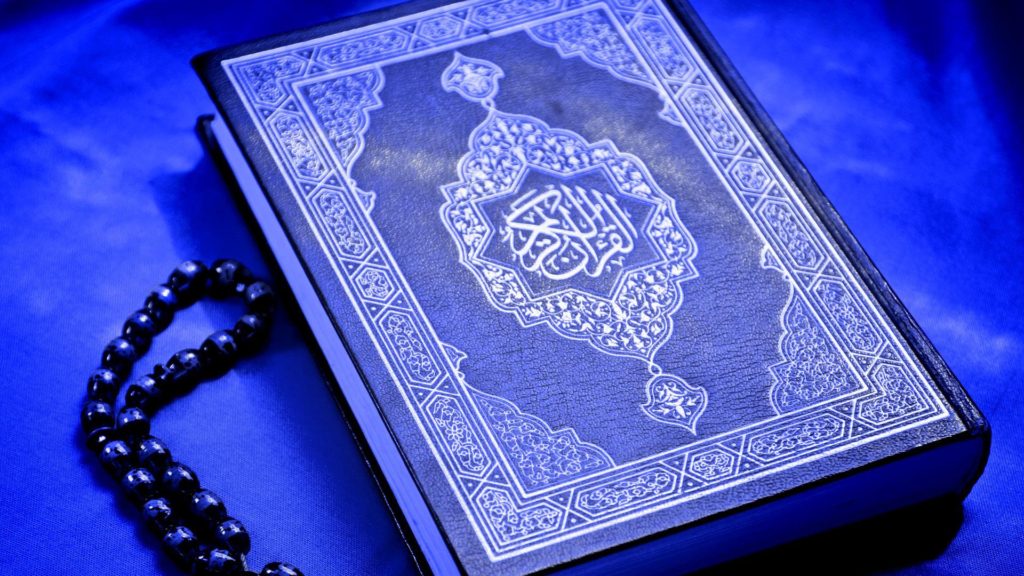
Morocco is a Muslim majority county where sometimes it can be hard to separate the two cultures. Separation of church does not exist, as the King also holds a second title of “Commander of the Faithful.” No matter where I am, whether bustling city or expansive desert, the Call to Prayer can almost always be heard and usually tends to act as a reminder of where I am in the world. I have adopted Moroccan culture the best I can into the way I take the tram, walk the streets, speak to servers and shopkeepers, etc. but the Call to Prayer, as well as some other Islamic influences on daily life, are quick to remind me that this country is not me and I am not this country. To truly understand Islam has been a difficult task, but Michael Sells Approaching the Quran: The Early Revaltions explains the word of God and the layout of the Quran in a very secular way.1 The Quran was not created in a way to be read but rather to be spoken aloud melodically and is also not arranged in chronological order. Sells compared it to trying to read the Bible in which “the second page opened with a combination of the legal discussions in Leviticus, the historical polemic in the book of Judges, and apocalyptic allusions from Revelation, with various topics mixed in together and beginning in mid-topic.”2 Even as someone who is not well versed in the Bible this seems very intimidating, and don’t forget the controversial translations and nonconformity in gender-specific terms. This complicated use of gendered terms in the Quran influences why it has traditionally been translated into He and Him, but some people, such as the Morchidat, are starting to provide alternate, gender inclusive, female promoting recitations and translations.
From a Western perspective of someone who is not well informed, this can make it seem that the Quran is male-centered and oppressive towards women but this is not necessarily the case. In actuality, “the gender dynamics within the Quran contains extraordinary balance that is constructed and modulated through sound figures.”3 Sells focuses specifically on the sound hā, which is related to female pronouns. Because of this, female specific actions such as giving birth and conceiving are able to hold deeper meanings and connections. The combination of all of these small factors can be seen in the story of Maryam (Mary) and Jesus. A lot of focus is put on her thoughts and feelings upon finding out she is pregnant, and the sound figures reinforce the female-ness of this experience. I am not a very religious person but I do believe it should be a very inclusive experience. You do not need a man to tell you what happened and how to feel, but rather you can read for yourself and allow the rhythmic flow in between female and male sound figures to let you have your own interpretation. I am aware that this is often not the case and not specific to any one religion, I just appreciate the ability to use religion and let religion influence you in your own personal way. I am not critical of anyone who practices or how they practice, but I think having some autonomy in practice and expression can be beneficial. I have seen this in Morocco as I have seen a majority of high school aged girls choose not to veil and may be reinterpreting what Islam means to them rather than simply rebelling.
1 Michael Sells, “Introduction,” Approaching the Quran: The Early Revelations (Ashland: White Cloud Press, 1999), 1-31.
2 Ibid, 3.3 Michael Sells, “Sound, Spirit, and Gender in the Quran,” Approaching the Quran: The Early Revelations (Ashland: White Cloud Press, 1999), 199-223.
 Where the sun sets