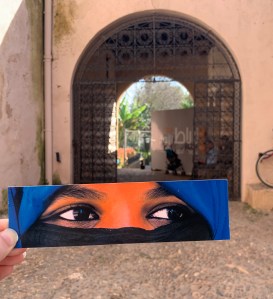
The way a Moroccan woman can move and present herself in a public space is differently complex compared to her American counterpart. Women are not barred from taking up space in public, but are affected by different institutional gender structures and heavy Islamic influence. “Allowable” public movement and presentation for Moroccan women are results of affluent and religious dependent dynamics between men and women, reinforced by age, class, and region. I want to observe how women from different regions, age groups, and social classes interact amongst themselves and with those around them in a culture that supports the ideology that public spaces are “strictly the man’s domain1“. I will define what public and private spaces mean in a Moroccan context in order to support my observations and to speculate on why things are the way they are. In addition to this, I will provide observational, contextualized evidence as to why public settings are seen as an “all boys club” and how this is starting to change. I cannot claim to write a Moroccan woman’s experience as I am not one, but I can observe interactions and engage in conversations to gain a better understanding of what it is like. Rachel Newcomb had a similar outlook for her research in Women of Fes where she had said that it is her attempt “to mark out and analyze the subtle area between what [she] witnessed and what people told [her]”2 because it is the only claim she could validly make.
There are many driving factors in deterring women from the streets towards their homes, such as religion and male entitlement, as well as many different interpretations of what space is and who can use it. Because of this, the way spaces are defined in a Moroccan context are not as simple as defining private as the home and public as those which are not. It is the types of interactions that can occur in a space which implies the definition3 and is supported by Islamic notions4. For example, a “public” space can be considered a private sphere of influence for women until an unknown male enters the room. Inversely, a “private” space, such as one’s home, can become a public space when guests are invited specifically by the male head of house,. When one is sharing space and has the ability to interact with someone of the opposite sex, the space becomes restricted for both parties. Other women and family members are mahrem5, so the restriction is not applicable during situations with them. It is this notion of the na-mahrem6 that necessitates a veil to be worn when in the presence of an unrelated male, thus becoming intertwined with the way women chose to move and take up space in public. As of now, the public is still “the man’s space” but the dynamics are changing in certain cities and it is clear to see that some women want to reclaim their position in society.
1 “Culture and Etiquette in Morocco,” Rough Guides, https://www.roughguides.com/destinations/africa/morocco/culture-etiquette/. This is not the only source I have to support this specific claim and will continue to justify this statement throughout my work.
2 Rachel Newcomb, Women of Fes: Ambiguities of Urban Life in Morocco, 7.
3 Shampa Mazumdar and Sanjoy Mazumdar, “Rethinking Public and Private Space: Religion And Women In Muslim Society,” in Journal of Architectural and Planning Research 18, no. 4 (2001).
4 This notion is based off of interactions with the opposite sex. I am making sure the way that spaces can be fluid in a Moroccan context is understood before describing the notion in much greater detail.
5 Those who women are forbidden to marry.
6 Those who women are not forbidden to marry.
 Where the sun sets